








That dull ache at the back of your jaw, the swollen gum that keeps flaring up, the bad taste that will not go away: these are common signs of a partially erupted wisdom tooth. When a third molar breaks through the gum only partway, it creates conditions that are difficult to manage with brushing alone. The question most people want answered is whether the situation will settle on its own or whether it needs professional attention.
For many adults, partially erupted wisdom teeth cause no lasting trouble. For others, the position of the tooth means repeated flare-ups are likely until the underlying issue is addressed, sometimes requiring wisdom tooth removal and care. The difference between the two comes down to how the tooth is sitting, how much room it has, and what the gum around it is doing.
Quick Overview
- A partially erupted wisdom tooth is a third molar that has broken through the gum surface but has not fully emerged into its correct position
- It may affect adults in their late teens or twenties, and in some cases causes no symptoms at all
- When symptoms do occur, they often involve gum inflammation, decay risk, or repeated infection in the surrounding tissue
- Whether monitoring or removal is appropriate depends on the tooth’s position, the pattern of symptoms, and individual oral health factors
- An X-ray is needed to assess what is happening beneath the gum before any decision is made
Keep reading to understand what a partially erupted wisdom tooth involves, what symptoms to watch for, and what a dentist may recommend.
What Is a Partially Erupted Wisdom Tooth?
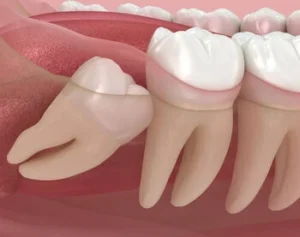 A partially erupted wisdom tooth is a third molar that has broken through the gumline but has not fully emerged. The tooth sits partially exposed and partially covered by a flap of gum tissue called the operculum.
This flap is the source of most problems. It creates a pocket between the gum and the tooth surface where food, bacteria, and debris collect. The area is difficult to clean with a toothbrush. Over time, bacteria accumulate, and the gum becomes inflamed, a condition called pericoronitis. Pericoronitis is one of the most common reasons people seek dental attention for wisdom teeth and related problems.
Lower wisdom teeth are more often affected than upper wisdom teeth, because they take longer to erupt and are more frequently angled or impacted.
What Are the Symptoms?
Not all partially erupted wisdom teeth cause symptoms. When they do, the presentation can range from mild and intermittent to more persistent discomfort that signals an active infection.
Gum swelling and tenderness: The gum around the partially erupted tooth becomes red, swollen, and sore. This may make it uncomfortable to bite down or chew on that side.
Bad taste or bad breath: Bacteria trapped beneath the gum flap produce an unpleasant taste or smell that does not clear with brushing. This is a common early sign of pericoronitis.
Jaw pain or jaw stiffness: When the surrounding tissue becomes inflamed, discomfort can spread to the jaw. In more significant infections, opening the mouth fully may become difficult.
Decay in the wisdom tooth or the tooth beside it: The tight space between a partially erupted wisdom tooth and the second molar beside it is one of the hardest areas in the mouth to clean. Plaque accumulates here, and decay can develop in both teeth.
Repeated infections: Some people experience one episode of pericoronitis that settles with treatment. Others find the infection keeps returning. Repeated infections are a significant factor in decisions about whether the tooth should be removed.
Why Does This Happen?
The most common underlying reason is a lack of space. Human jaws often do not have enough room for four additional molars to erupt fully and comfortably. When space runs out, the wisdom tooth gets stuck partway through and cannot progress further.
The angle of the tooth also matters. A wisdom tooth growing at a forward angle pushes into the second molar beside it. A tooth growing sideways or backwards may become lodged against bone. Neither position allows the tooth to erupt cleanly, and both create ongoing cleaning problems.
In some cases, a partially erupted wisdom tooth may eventually erupt fully and settle without causing further issues. In others, the position is such that full eruption is not possible and the tooth will remain partially covered indefinitely. An X-ray is the most reliable way to assess which situation applies. Common reasons a dentist may recommend removing a wisdom tooth include repeated infection, decay, and ongoing pressure on adjacent teeth.
When Does a Partially Erupted Wisdom Tooth Need to Come Out?
Not every partially erupted wisdom tooth needs to be extracted. A dentist will consider several factors before making a recommendation, and individual circumstances vary considerably.
Extraction is more likely to be recommended when:
- The tooth has caused two or more episodes of pericoronitis
- Decay has developed in the wisdom tooth or the adjacent second molar
- The tooth is pressing against the second molar and causing damage or discomfort
- There is not enough space for the tooth to erupt fully into a functional position
- The gum around the tooth is consistently inflamed despite good oral hygiene
Monitoring may be appropriate when the tooth is symptom-free, the surrounding gum is healthy, and X-rays suggest the position is not causing ongoing harm to nearby teeth.
The decision is not always straightforward. A dentist will use X-rays to assess the tooth’s roots, its relationship to nearby nerves, and the amount of bone around it before discussing options. How a dentist evaluates whether wisdom tooth removal is appropriate depends on a combination of clinical findings and individual circumstances.
What Does Removal Involve?
When extraction is recommended, the procedure depends on how deeply the tooth is embedded and how it is positioned.
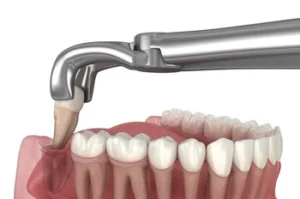 For a partially erupted tooth that has some visible structure above the gumline, the procedure may be relatively straightforward under local anaesthetic. For a tooth that is more deeply angled or impacted, a small incision in the gum may be needed to access and remove it in sections. This is still commonly performed under local anaesthetic, though general anaesthetic is an option for patients who prefer it or where multiple teeth are being removed.
After removal, a blood clot forms in the socket and healing begins over the following days and weeks. Soft foods, avoiding rinsing forcefully, and following aftercare instructions help protect the socket during recovery. Dry socket, where the blood clot is lost before the socket heals, is an uncommon but manageable complication.
A Considered Approach to a Partially Erupted Wisdom Tooth
A partially erupted wisdom tooth does not always need immediate action. In some cases it settles; in others, monitoring or timely removal is the more appropriate path.
What matters is having an accurate picture of the tooth’s position and the condition of the surrounding gum and bone. Without an X-ray and a clinical assessment, it is not possible to determine which applies. Individual outcomes vary depending on the angle of the tooth, the pattern of any symptoms, and overall oral health.
If you are experiencing symptoms or want an assessment of your wisdom teeth, we welcome you to get in touch with Complete Dental.
- Contact Elanora Clinic: 07 5235 8199
- Contact Coorparoo Clinic: 07 3801 6503
Note: Any surgical or invasive procedure carries risks. Before proceeding, you should seek a second opinion from an appropriately qualified health practitioner.
Frequently Asked Questions
What does a partially erupted wisdom tooth feel like?
The most common sensation is a dull ache or tenderness at the back of the mouth, often worsening when chewing. The gum around the tooth may feel swollen or tender to touch. Some people also notice a bad taste or mild jaw stiffness. Symptoms tend to come and go, with flare-ups often triggered by stress, illness, or food becoming trapped under the gum flap. Individual experiences vary.
Can a partially erupted wisdom tooth fix itself?
In some cases, a partially erupted wisdom tooth continues to erupt over time and eventually settles into a functional position without causing further problems. In other cases, particularly where space is limited or the tooth is angled, full eruption is not possible, and the tooth remains partially covered indefinitely. An X-ray and clinical assessment are needed to determine which situation applies.
References
Better Health Channel. (2022). ‘Wisdom Teeth’. Better Health Channel, 3 June. Melbourne, VIC: Department of Health, State Government of Victoria. https://www.betterhealth.vic.gov.au/health/conditionsandtreatments/wisdom-teeth
Healthdirect Australia. (2026). ‘Removing Wisdom Teeth’. Healthdirect Australia, January. Canberra, ACT: Australian Government Department of Health. https://www.healthdirect.gov.au/surgery/removing-wisdom-teeth
Teeth.org.au. (n.d.). ‘Wisdom Teeth’. Teeth.org.au. Sydney, NSW: Australian Dental Association. https://www.teeth.org.au/wisdom-teeth